Amazon S3 in Claude, ChatGPT and any MCP client. For your whole team.
Files in an Amazon S3 bucket or S3-compatible storage: list, read, upload and move, confined to one bucket and folder. One technical login in Loopthink, one login per person, roles per tool and an audit entry for every call.
Free for 2 connectors, no card · Pro €19 · EU-hosted · 3 read tools, 4 write tools off by default
“What landed in the exports folder today?”
Three objects arrived today:
| Object | Size | Last modified |
|---|---|---|
| orders-2026-11-16.csv | 412 KB | 16 Nov 02:10 |
| customers-delta.json | 38 KB | 16 Nov 02:12 |
| stock-levels.csv | 96 KB | 16 Nov 05:30 |
- read-only
- masked
Credentials in once, the tools come out.
Buckets are where exports, backups, reports and partner deliveries end up: a CSV from the shop every night, JSON from an integration, log files, the monthly report. Reading one means the right console, the right rights and a download, every time.
With the S3 connector, Operations, Finance and Data ask in Claude or ChatGPT, or in the ChatGPT app "S3 by Loopthink", what arrived and what it says. One server reaches exactly one bucket and can be confined to a folder (prefix): nothing outside it can be listed, read or written. Loopthink holds the access key, every person signs in with their own identity, and every call is logged under their name with the path it touched.
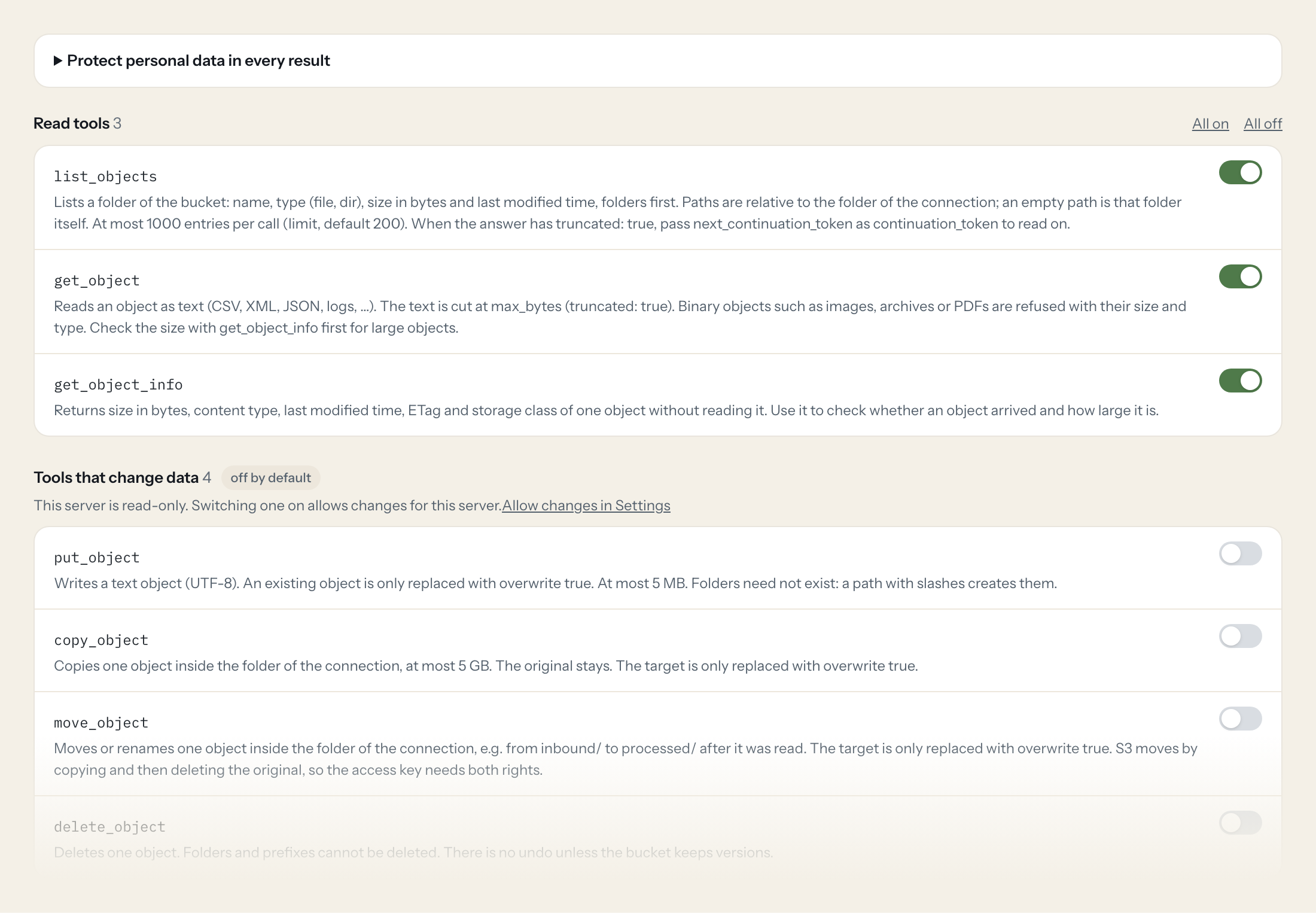
Three read tools list a folder, read a text object and show an object's size and date. Four write tools, put, copy, move and delete, stay off until you switch them on for a role. It works with Amazon S3 and, through an endpoint field, with S3-compatible storage such as Hetzner Object Storage, IONOS, Wasabi, Backblaze B2 and Cloudflare R2.
- Operations
“Which exports landed in the reports folder today?”
Answered by
list_objects - Finance
“Read yesterday's CSV export and sum the amounts per country.”
Answered by
get_object - Operations
“How large is the newest backup, and when was it written?”
Answered by
get_object_info - Data
“Compare the two newest JSON files in the inbound folder.”
Answered by
get_object - Operations
“Put this summary as a text file into the outbox.”
Answered by
put_object - Operations
“Move the files I just checked to processed.”
Answered by
move_object
What the Amazon S3 connector can do.
| Tool | What it does | Access | Default |
|---|---|---|---|
| list_objects | Lists a folder of the bucket: name, type (file, dir), size in bytes and last modified time, folders first. Paths are relative to the folder of the connection; an empty path is t… | Read | On |
| get_object | Reads an object as text (CSV, XML, JSON, logs, …). The text is cut at max_bytes (truncated: true). | Read | On |
| get_object_info | Returns size in bytes, content type, last modified time, ETag and storage class of one object without reading it. Use it to check whether an object arrived and how large it is. | Read | On |
| put_object | Writes a text object (UTF-8). An existing object is only replaced with overwrite true. | Write | Off |
| copy_object | Copies one object inside the folder of the connection, at most 5 GB. The original stays. | Write | Off |
| move_object | Moves or renames one object inside the folder of the connection, e.g. from inbound/ to processed/ after it was read. | Write | Off |
| delete_object | Deletes one object. Folders and prefixes cannot be deleted. | Write | Off |
Write tools are off for every role until you switch them on, one tool for one role. The names are what the model sees; it also gets the full parameter description of each tool.
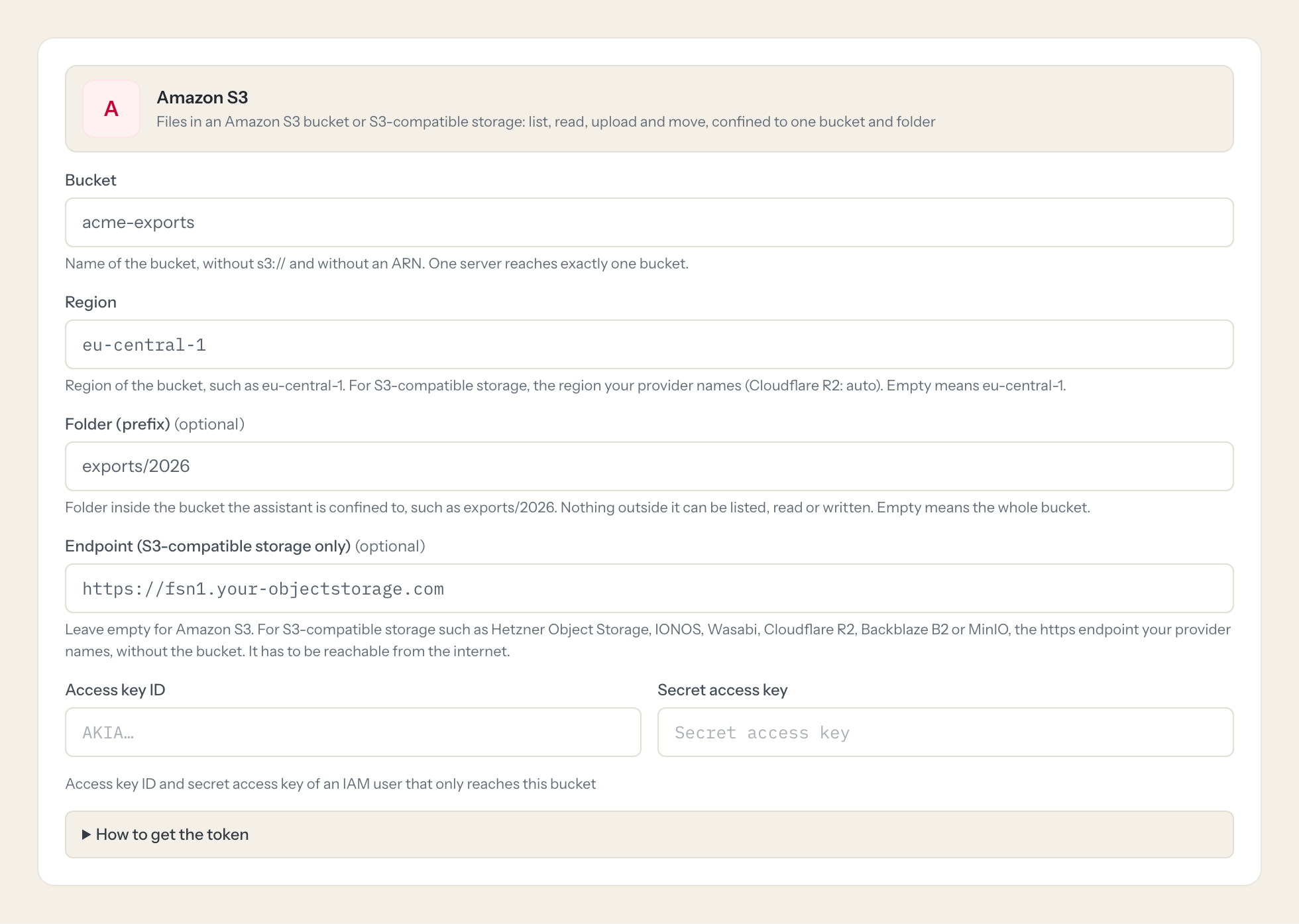
Setting up access to Amazon S3.
Five minutes, once. Nobody on your team ever sees the credentials.
- 1
In the AWS console open IAM, then Users, and create a dedicated user for the assistant. It needs no console access.
- 2
Attach an inline policy that only reaches this bucket. For reading: {"Version":"2012-10-17","Statement":[{"Effect":"Allow","Action":"s3:ListBucket","Resource":"arn:aws:s3:::YOUR-BUCKET"},{"Effect":"Allow","Action":"s3:GetObject","Resource":"arn:aws:s3:::YOUR-BUCKET/*"}]} (replace YOUR-BUCKET with the bucket name).
- 3
Only when the assistant should also write: add s3:PutObject and s3:DeleteObject to the second statement, allow changes on the connection and switch on the write tools.
- 4
Open the user's Security credentials tab and create an access key (use case: Application running outside AWS).
- 5
Paste the access key ID and the secret access key here. The secret is shown only once in the AWS console.
- 6
Click 'Test connection'. It lists one entry of the bucket.
- 7
In Loopthink, add Amazon S3 from the catalog and enter the access key ID and secret access key. It also asks for bucket, region, folder (prefix) and endpoint (s3-compatible storage only). Your team sees the tools a minute later.
S3-compatible storage (Hetzner Object Storage, IONOS, Wasabi, Cloudflare R2, Backblaze B2, MinIO): create an access key that is limited to this bucket in your provider's console, and enter the provider's endpoint and region. To confine the key itself to a folder on AWS, narrow the object resource to arn:aws:s3:::YOUR-BUCKET/folder/* and add the condition s3:prefix to s3:ListBucket.
What we suggest masking in Amazon S3.
Exports and partner files carry names, e-mail addresses and IBANs in every line. Object contents come back in one field, so a rule on content removes or masks them for a role, and the IBAN and e-mail patterns catch those values wherever they appear. Give Finance the content and other roles the list of objects.
- content
- name
Amazon S3 and Loopthink
- Can the assistant reach other buckets or folders?
- No. One server is one bucket, and with a folder set, every path is resolved inside it: nothing above it can be listed, read or written. For a second bucket you add a second server. To confine the access key itself as well, give its IAM user a policy that only reaches this bucket or folder; the setup steps show one.
- Does it work with Hetzner, IONOS, Wasabi or Cloudflare R2?
- Yes. Enter your provider's endpoint, such as https://fsn1.your-objectstorage.com for Hetzner Object Storage, and the region it names (auto for Cloudflare R2). The endpoint has to be reachable from the internet; a MinIO that is reachable works the same way. Leave the endpoint empty for Amazon S3.
- Which objects can it read, and how large?
- Text: CSV, JSON, XML, logs and the like, 256 KB per call unless the assistant asks for more, up to 2 MB, cut with a note when longer. Binary objects such as images, archives or PDFs are not read; the assistant gets their type and size. Uploads are text up to 5 MB, and an existing object is only replaced when you say so.
- Is this the same as the ChatGPT app "S3 by Loopthink"?
- Yes. The app is the quickest way in from ChatGPT: you add it, sign in, and a form on our page asks for bucket, region and access key, then lists the bucket once to test it. In ChatGPT the tools are called s3_list_objects, s3_get_object, s3_get_object_info and, where switched on, s3_put_object, s3_copy_object, s3_move_object and s3_delete_object. Claude and other MCP clients reach the same bucket through your Loopthink connector, with the same roles and the same log.
- Does every team member need their own Amazon S3 account?
- No. Loopthink holds one key or token for Amazon S3. Your people sign in to Loopthink with their own identity, and every call to Amazon S3 is logged under their name. Seats in Amazon S3 stay where they are today.
- Where does the Amazon S3 key live?
- In Loopthink, encrypted, in the EU. It never reaches the AI client and never reaches the people using the connector. Rotate it in Amazon S3 whenever you like and paste the new one once.
- Can somebody write to Amazon S3 from the chat?
- Not unless you switch it on. Write actions are a separate row in the permission matrix and are off for every role by default. If a role needs one write tool, you grant that one tool to that one role.
- What does the model see?
- The result of the tool call, after masking. Fields you mark as personal, such as emails, names or card details, are masked before the answer travels to the AI client. The model gets the numbers, not the people.
- What does it cost?
- Free for one person and two connectors, no card. Pro is €19 a month for up to five people and every connector on the site, with roles, field masking and a 30-day audit. Team is €49 for ten people and adds your own REST APIs and SQL databases, your own domain and your own identity provider. No call needed.
Stuck, or a tool you need is missing? A person who knows this connector answers within one working day.

